
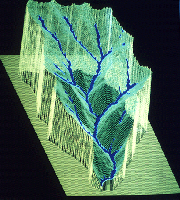
INCA climate change project
The model suggests that nitrate-nitrogen concentrations will increase to levels close to the EU drinking water limits of 11.3 mg/l. Falling flow rates and rising nitrate levels could affect water supply and will also put in doubt plans to improve water quality and ecology of such a sensitive chalk stream as the Kennet.
A series of adaptation strategies have been investigated using the model to see if it is possible to mitigate the effects of climatic change. For example, reducing agricultural fertiliser use by 50% in the catchment has the biggest improvement (dotted line below), lowering nitrate concentrations to levels not seen since the 1950s. Reducing atmospheric sources of Nitrate and Ammonia by 50% does reduce the nitrate by about 1 mg/l compared with the climate effects (see grey line) but is a much smaller effect. Constructing water meadows along the river would be more beneficial, significantly slowing down the rising levels of nitrate (see dashed/dotted line). However, a practical proposition might be a combination of all three approaches to reduce fertiliser use by 25%, reduce deposition by 25% and to construct some wetland areas along the river system. This generates significant reductions in nitrate in the river (see black line).
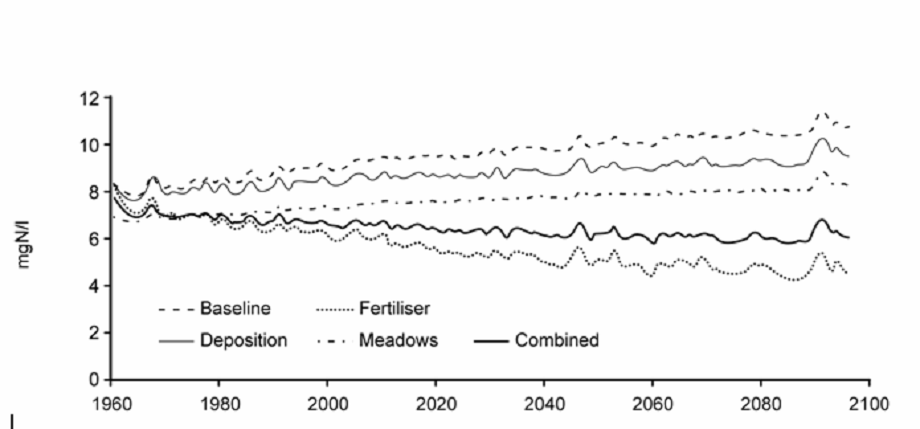
Simulating the effects of climate change from 1960-2100 on nitrate-nitrogen concentrations in the River Kennet together with a set of Adaptation Strategies
In a study of the likely future impacts of climate change on hydrology and water quality in the River Kennet, it has been shown that summer flow rates in the river are likely to fall in the future as drought periods becoming more extreme. Extending the modelling to simulate nitrate-nitrogen it is shown that the droughts will trigger a release of nitrate from the soils and this nitrate will inevitably end up in the river.
Back to INCA climate change study home page
Back to research home page


